Ceramic Pressure Sensors: The Prevailing Trend in Pressure Sensor Development
Ceramic Pressure Sensors: The Prevailing Trend in Pressure Sensor Development
The ceramic pressure sensor is a piezore…
The ceramic pressure sensor is a piezoresistive type pressure sensor precision-manufactured from special ceramic materials through special processes. Ceramic is a recognized material with high elasticity and strong resistance to corrosion, wear, impact and vibration. Its thermal stability and thick-film resistors give it an operating temperature range as wide as -40°C to 125°C, together with high measurement accuracy and high stability. Electrical insulation exceeds 2 kV, the output signal is strong, and long-term stability is excellent.
High-performance, low-cost ceramic sensors represent the future direction of pressure sensors. In Europe and America, ceramic sensors are trending toward fully replacing other types of sensors, and in China a growing number of users are adopting them as substitutes for diffused-silicon pressure sensors.
Classification of Ceramic Pressure Sensors
The substrate of ceramic pressure sensors is Al2O3 ceramic. Based on their operating principle, they can be divided into capacitive pressure sensors and piezoresistive pressure sensors.
① Ceramic Capacitive Pressure Sensors
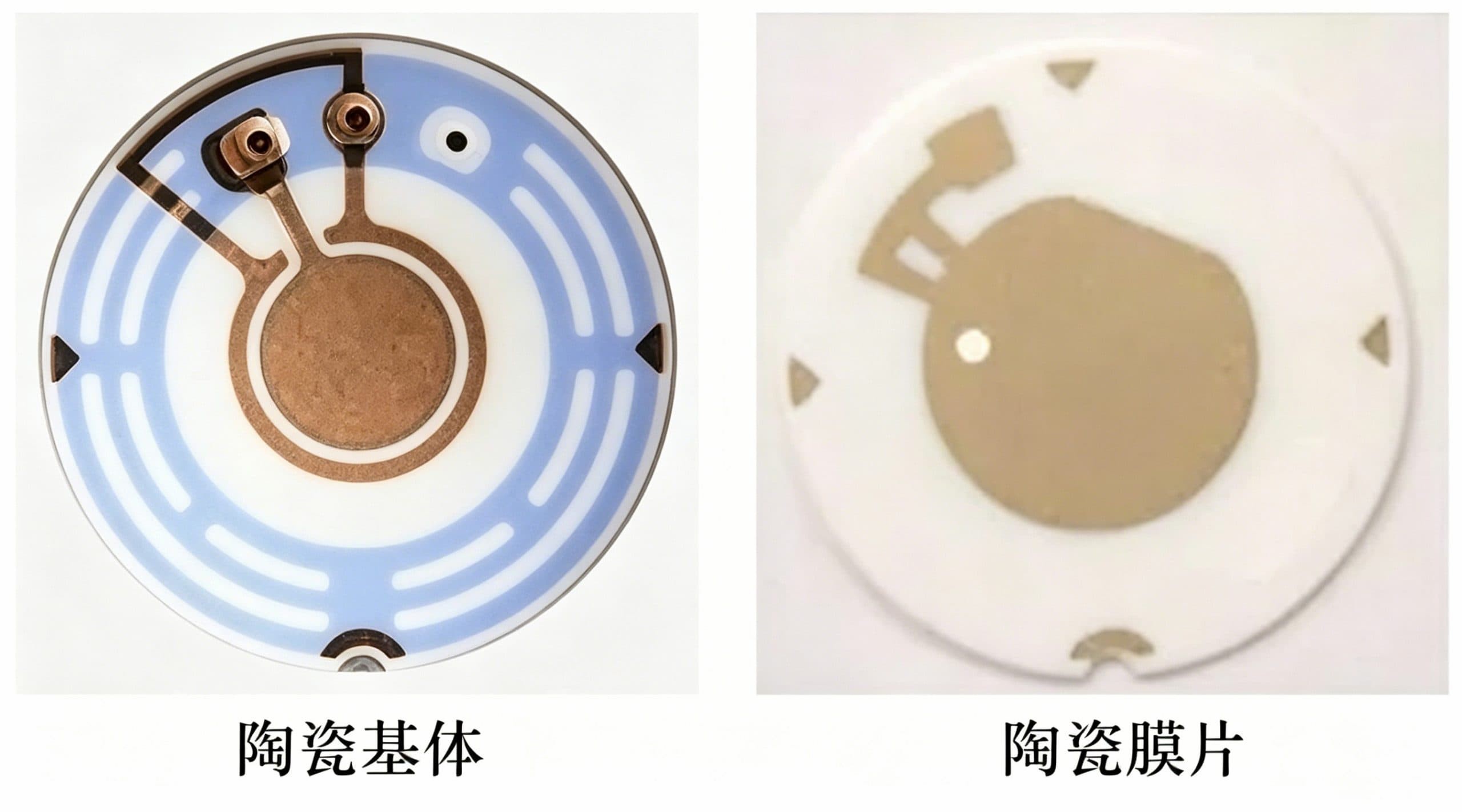
The ceramic capacitive pressure sensor adopts a fixed ceramic base and a movable ceramic diaphragm structure; the movable diaphragm is hermetically bonded to the base by glass frit or similar means. Electrode patterns are printed on the inner facing surfaces of the two parts, forming a variable capacitor. When the medium pressure acting on the diaphragm changes, the capacitance between the two changes accordingly, and a signal-conditioning chip converts and conditions this signal for downstream use. Ceramic capacitive technology offers moderate cost, a wide measuring range, good temperature characteristics, good consistency and excellent long-term stability.
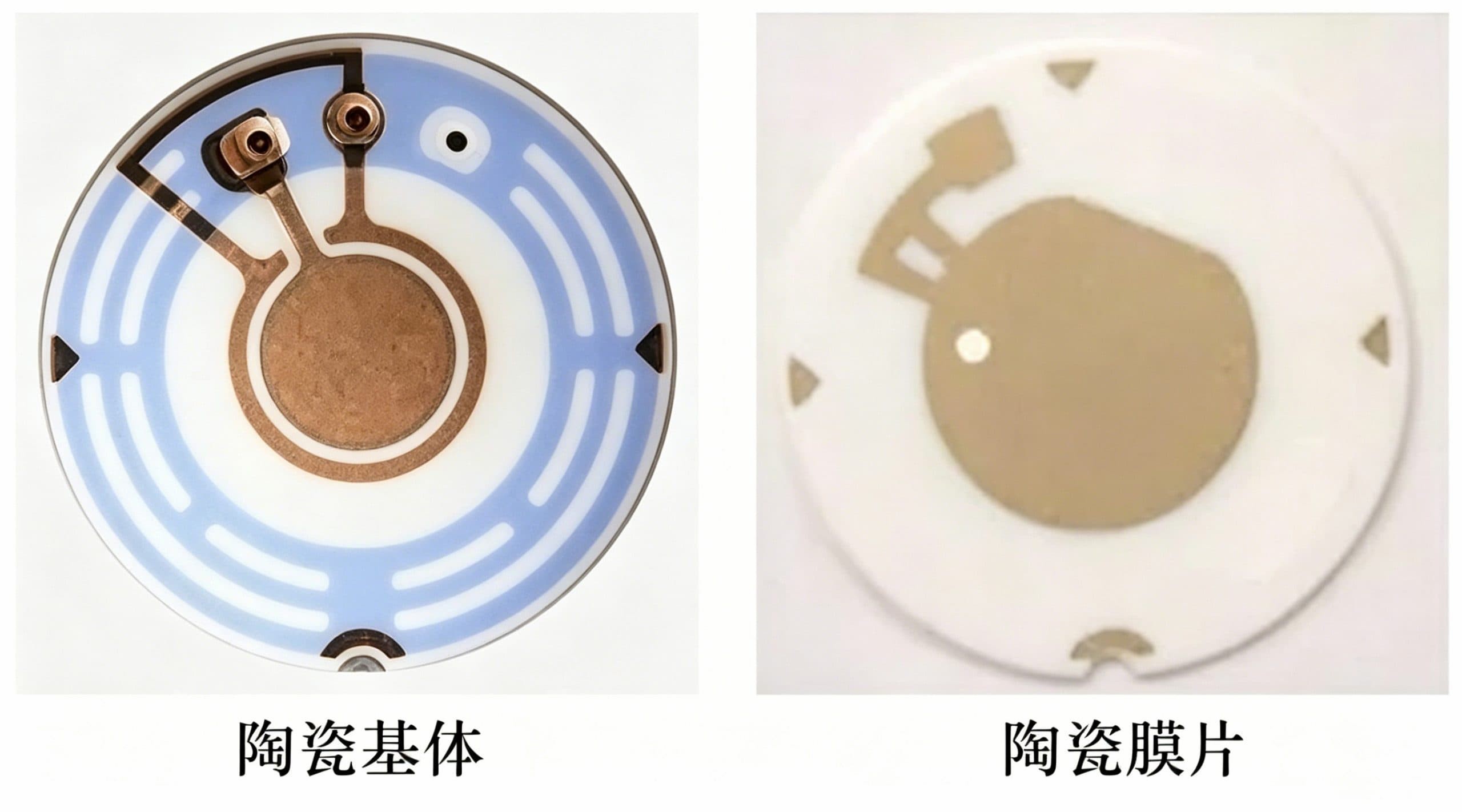
▲ Structural schematic of the ceramic capacitive sensing element
Because the edge of the ceramic diaphragm is fixed on the ceramic base — supported around its periphery — the deformation under load is largest at the center and smallest at the edge, producing capacitance nonlinearity and reduced sensitivity. To minimize temperature effects and edge effects, the design places a single circular electrode on the ceramic diaphragm as the common electrode, and two electrodes of equal area on the ceramic cover plate, forming a coaxial ring-shaped dual-capacitor sensor.
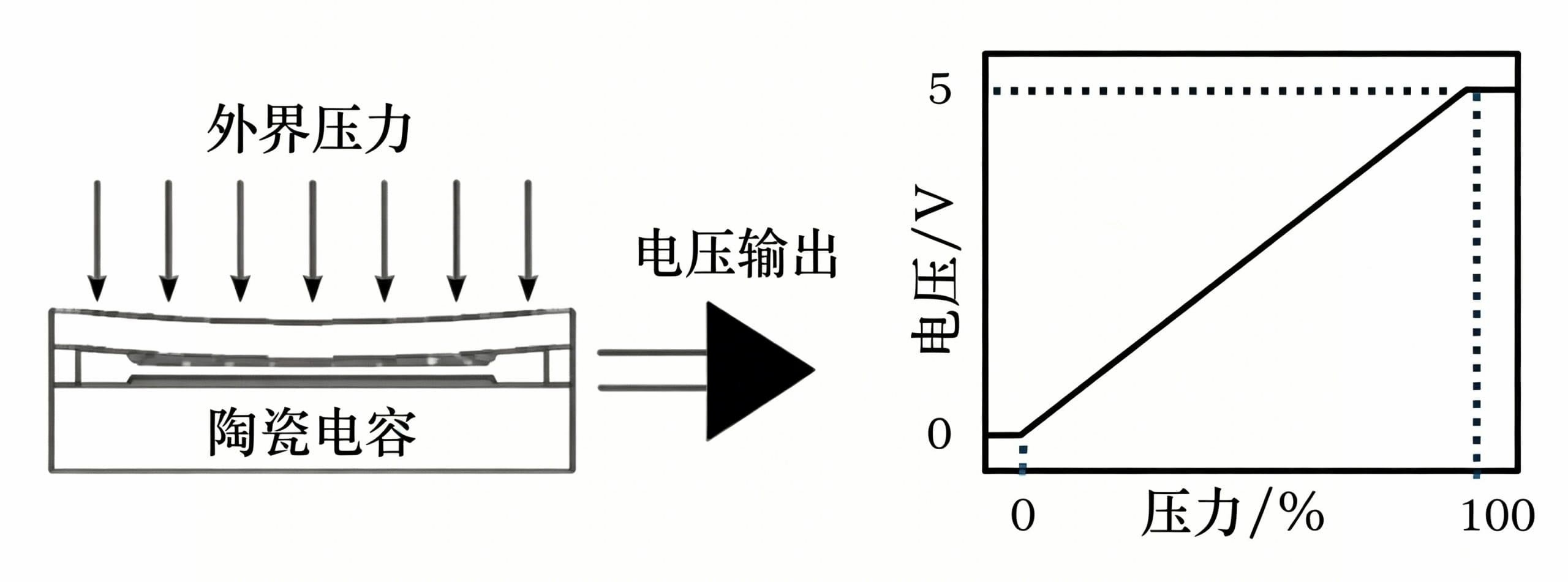
▲ Principle of the ceramic capacitive pressure sensor
The center is the measuring capacitor Cp, the outer ring is the reference capacitor Cr, and beyond Cr is the clamped edge. The subsequent signal-conditioning circuit processes the differential between the two capacitors: square-wave excitation converts the changes in Cp and Cr into DC voltage outputs respectively, and the applied pressure is measured from the difference between the two output voltages.
The dual-capacitor structure greatly reduces the nonlinear error of the sensor system. Moreover, when the ambient temperature changes, both capacitors experience the same temperature variation, so the temperature effects on them are identical — cancelling the measurement error caused by temperature change and achieving temperature self-compensation.
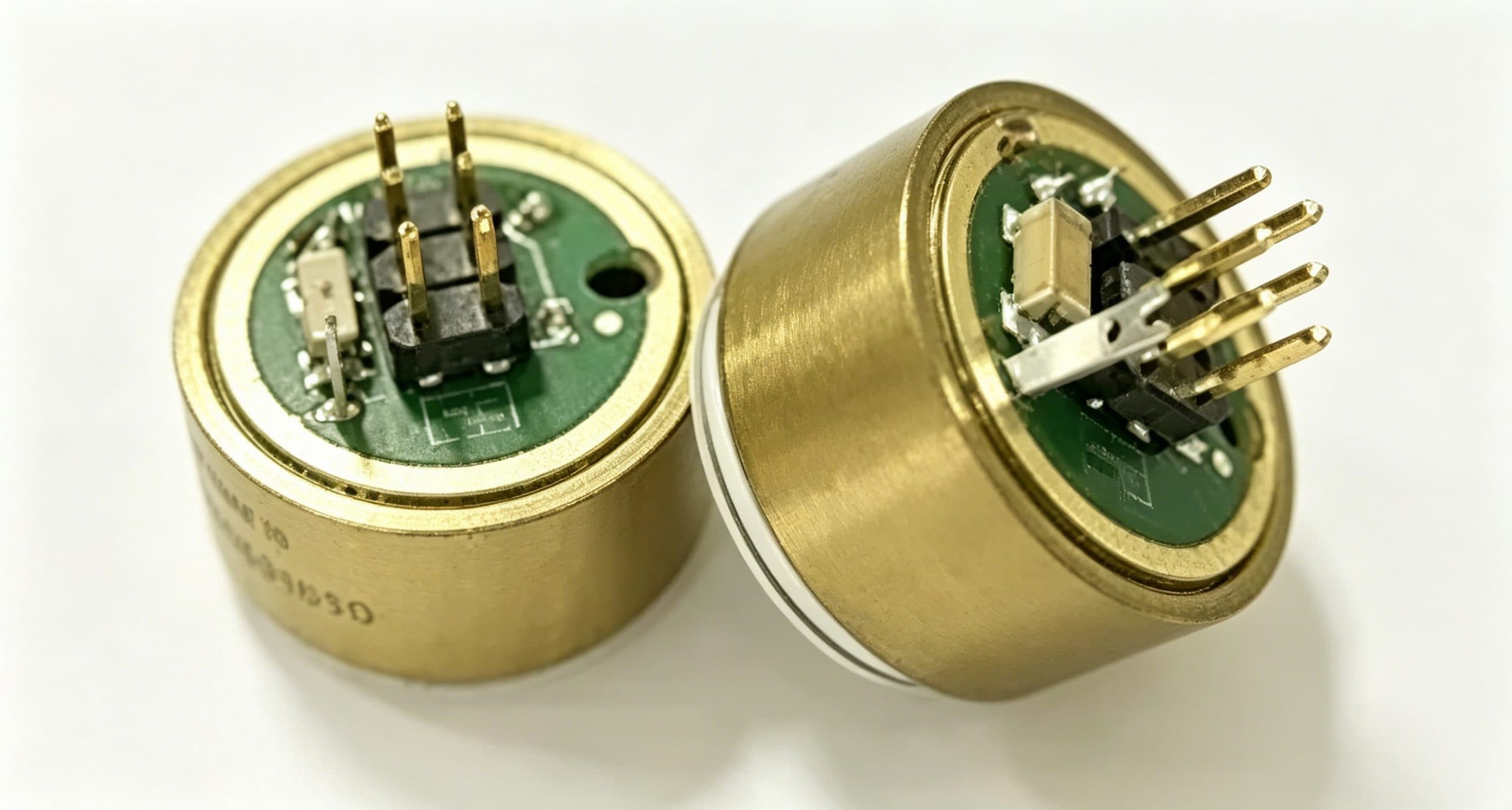
▲ Ceramic capacitive pressure sensor (image source: internet)
With their corrosion resistance, impact resistance, zero hysteresis and strong media compatibility, ceramic capacitive pressure sensors can be widely applied to pressure measurement of water, gas and liquid media, and are particularly suitable for the harsh environments of automotive systems. For emerging application markets such as IoT and home appliances, the impact resistance of ceramic capacitance can be applied to water-pressure measurement in supply networks, perfectly coping with the water-hammer effect; for variable-pressure rice-cooker applications, the flat-diaphragm structure of ceramic capacitance avoids clogging.
② Ceramic Piezoresistive Pressure Sensors
The ceramic piezoresistive pressure sensor consists mainly of three parts: the ceramic ring, the ceramic diaphragm and the ceramic cover plate. The ceramic diaphragm serves as the force-sensing elastic body; a Wheatstone bridge is formed on it by thick-film process technology as the sensor circuit, generating a voltage signal through the piezoresistive (strain) effect of the resistors.
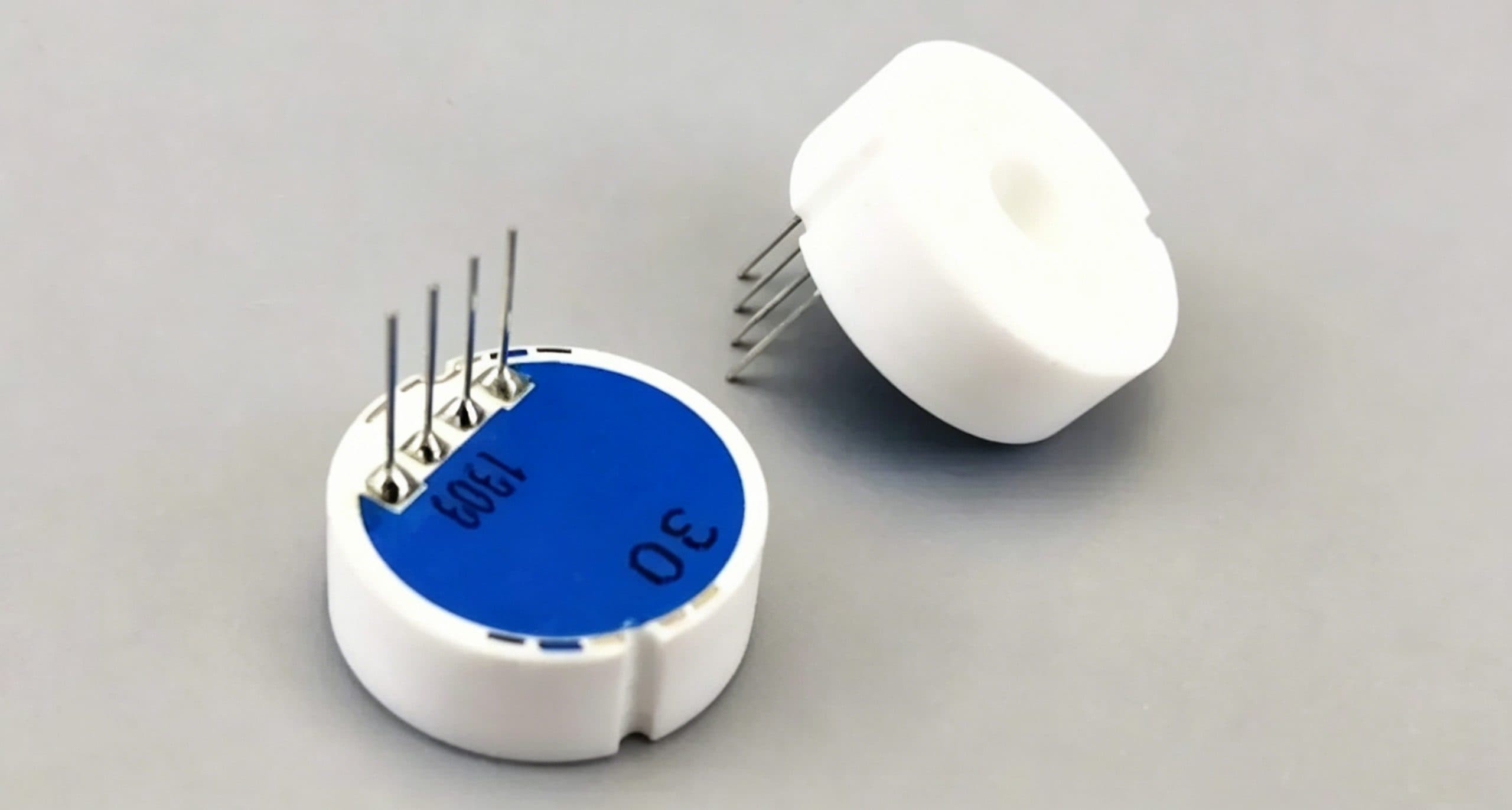
▲ Ceramic piezoresistive pressure sensor (image source: internet)
Thick-film resistors are printed on the back of the ceramic diaphragm and connected into a (closed) Wheatstone bridge. At zero pressure the bridge is balanced and the output voltage is zero; when pressure is applied, the diaphragm deforms, changing the resistance of the four bridge arms and unbalancing the bridge, producing a voltage signal that is highly linear and proportional to the pressure — and also proportional to the excitation voltage. Standard signals are calibrated as 2.0/3.0/3.3 mV/V etc. depending on the pressure range, making them compatible with strain-gauge sensors. Through laser calibration, the sensor achieves very high temperature stability and time stability; it comes with built-in temperature compensation of 0–70°C and can be in direct contact with most media.