Geometric Structural Design and Functional Expansion in Piezoelectric Ceramic Devices
Geometric Structural Design and Functional Expansion in Piezoelectric Ceramic Devices
Piezoelectric ceramics, capable of bidir…
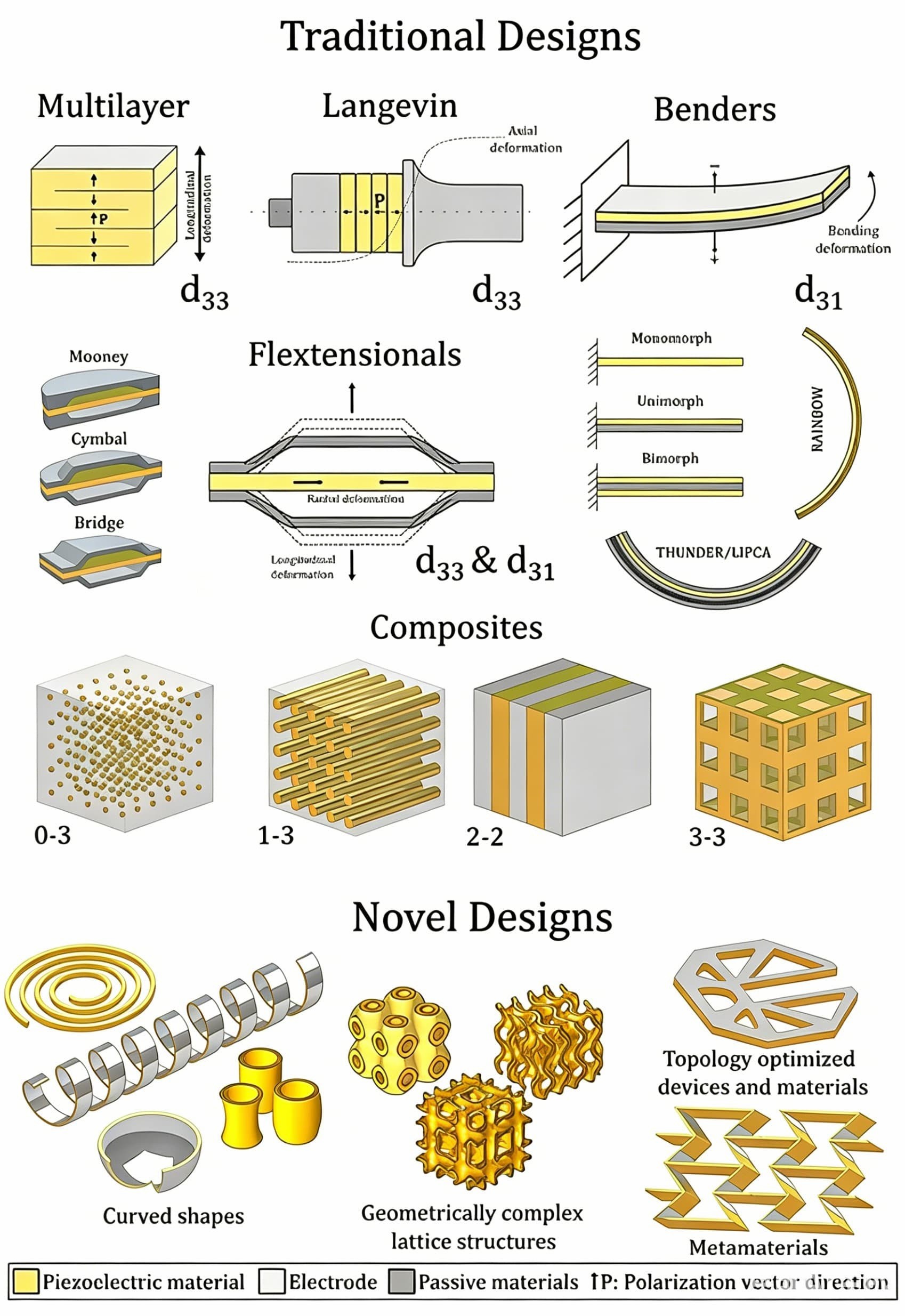
Piezoelectric ceramics, capable of bidirectional conversion between mechanical and electrical energy, are widely used in energy harvesters, transducers, robotics and other fields. With the development of additive manufacturing technologies such as 3D printing, complex geometries that are difficult to achieve by traditional machining are gradually becoming possible. This article reviews the influence of geometric shape on energy-conversion performance in piezoelectric ceramic devices, covering a variety of typical designs including multilayer structures, benders, spirals, shells, topology-optimized structures and metamaterials, providing a reference for the design and manufacture of novel piezoelectric devices.
Introduction to Piezoelectric Ceramics
The piezoelectric effect couples mechanical and electrical energy, and piezoelectric materials play important roles in numerous key technologies. The direct piezoelectric effect is widely used in various sensors, ultrasonic equipment and energy harvesters, while the converse piezoelectric effect is commonly used in high-precision actuators and high-power ultrasonic systems. The global piezoelectric ceramics market is currently valued at approximately USD 2 billion and is dominated by lead-containing ceramics such as PZT. Compared with single-crystal materials, ceramics offer greater workability and can be relatively easily fabricated into a variety of complex shapes, making them the core direction of piezoelectric material research and application.
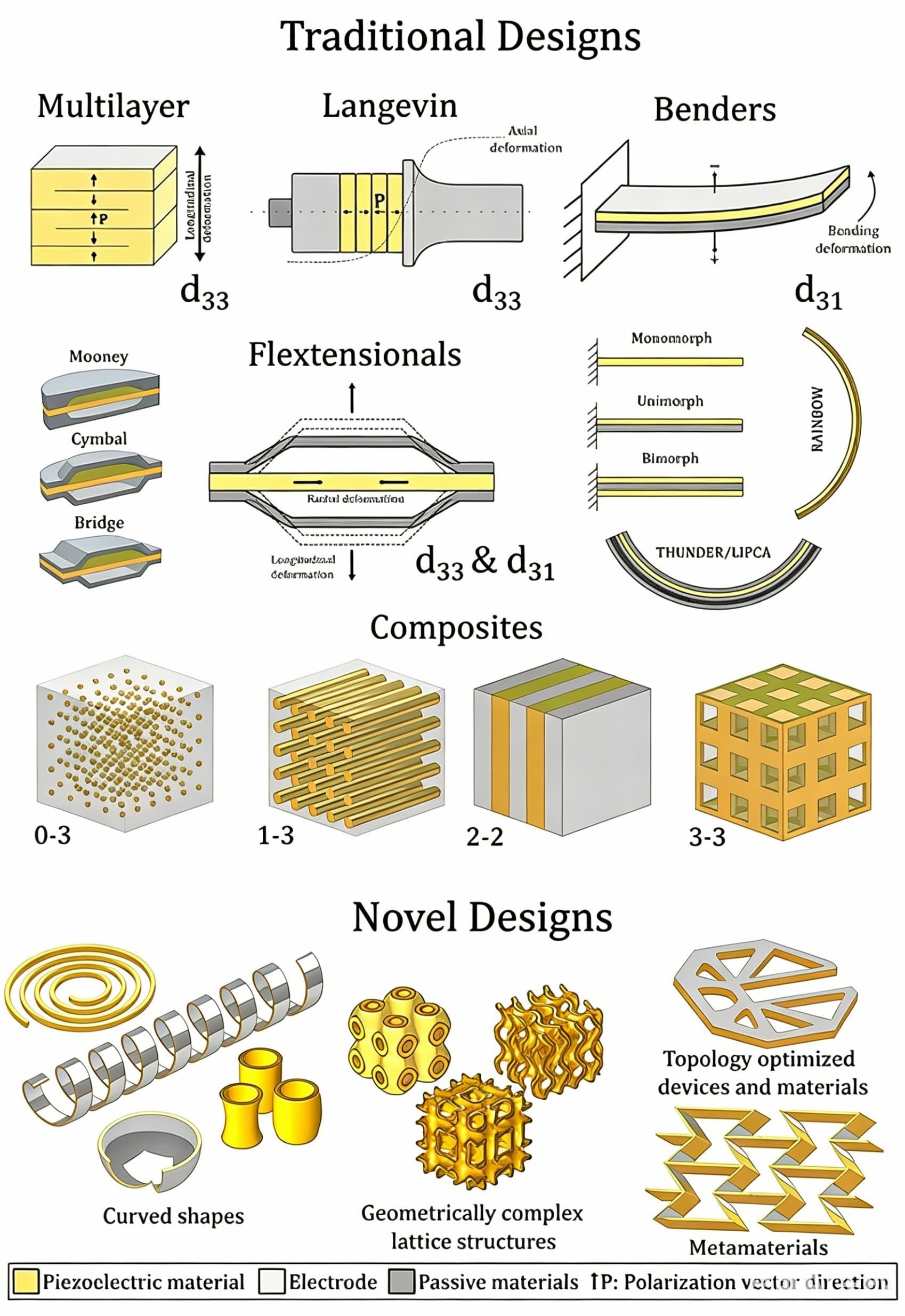
▲ Architecture of piezoelectric devices
Design of Piezoelectric Ceramic Shapes
Although piezoelectric ceramics have long been used in traditional forms such as discs, plates, rings and tubes, advances in manufacturing methods have made unconventional piezoelectric ceramics with complex shapes and electrode/polarization networks possible.
The shape of a piezoelectric element affects its vibration modes, and consequently the analytical expression of its electromechanical coupling factor, as shown below. Piezoelectric elements whose aspect ratios differ from the standard requirements produce overlapping responses from multiple vibration modes. This complicates the interpretation of impedance spectra when characterizing material parameters and necessitates additional data analysis, especially when these elements serve as sensors in devices.
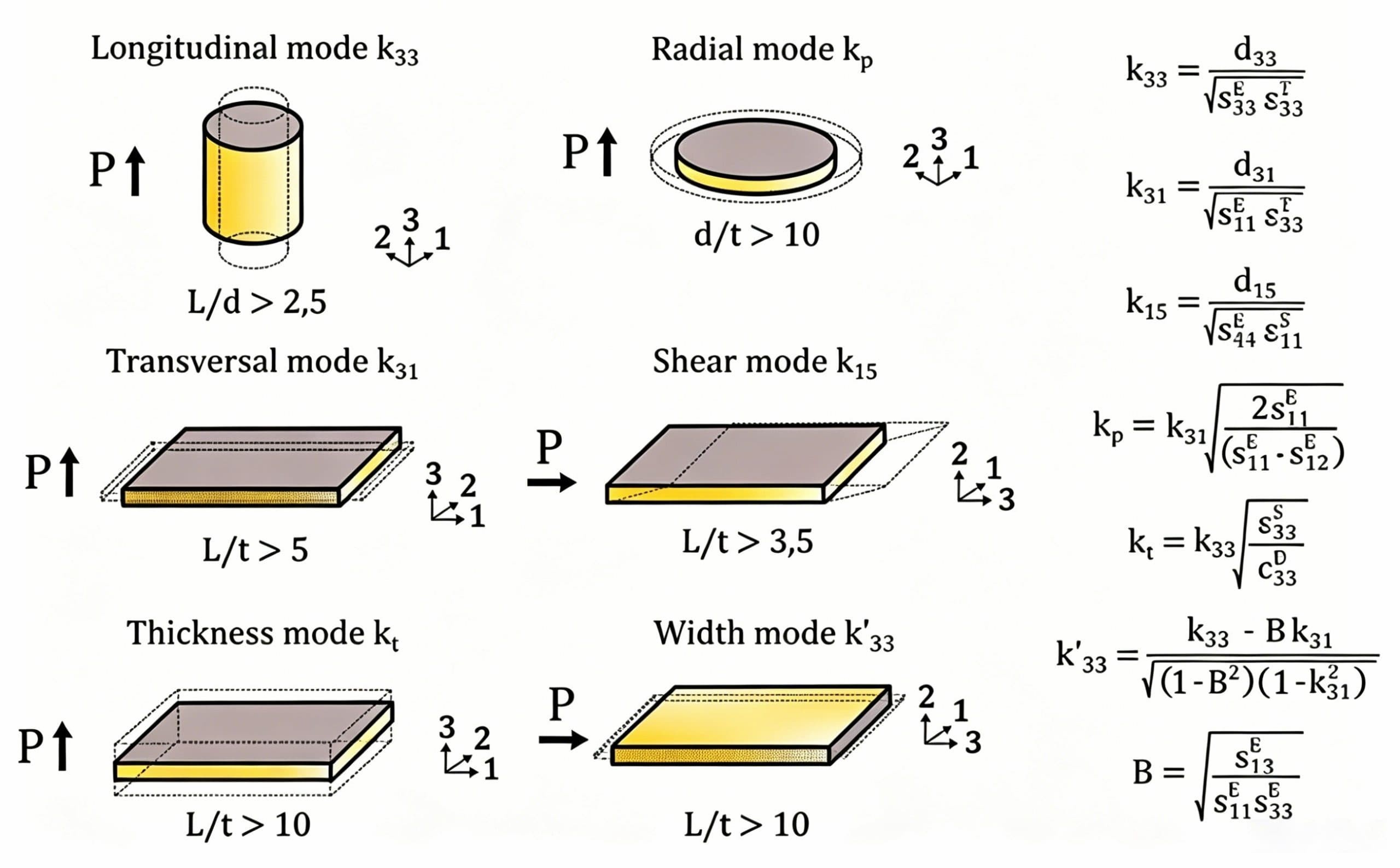
▲ Electromechanical coupling coefficients of several resonance modes, where t is thickness, d is diameter, L is other dimensions, and P is the polarization direction
The geometry of a piezoelectric element significantly affects the type and magnitude of its coupling coefficients. For example, a thin disc has a lower coupling coefficient in the same direction than a plate or rod structure. Transitioning the shape from disc to rod or bar enhances the longitudinal response. Variations in aspect ratio also affect the measured charge coefficients (e.g. d₃₃). The “effective” d₃₃ value measured in experiments may differ from the intrinsic d₃₃ of the material: Barzegar et al. found that the d₃₃ value of thin PZT discs is generally reduced by about 30%, and Stewart et al. further found that thickness effects in thin discs reduce the d₃₃ value of soft PZT while increasing that of hard PZT.
Another key shape-related factor is curvature. In curved structures, the displacement caused by the d₃₃ component is more pronounced at the edges, and the bending moment generated by the normal piezoelectric stress is significantly larger in curved structures than in straight ones, further enhancing the piezoelectric response.
Piezoelectric Ceramics as Ultrasonic Transducers
Ultrasonic transducers are one of the most important commercial applications of piezoelectric ceramics. The thickness of the piezoelectric ceramic directly determines the frequency of the emitted ultrasound, which affects the spatial resolution and penetration depth of imaging. In medical ultrasound applications, lower frequencies (e.g. 5 MHz) are used for imaging deep organs, corresponding to a ceramic thickness of about 0.45 mm, while higher frequencies (e.g. 40 MHz) are used for imaging superficial features, corresponding to a thickness of only about 57 μm. Developing thinner piezoelectric ceramic devices is therefore key to high-resolution medical imaging.
Meanwhile, to ensure a stable ultrasonic propagation mode, the device requires a high aspect ratio to avoid interference from non-target modes. Such structures usually adopt thin-rod geometries, exciting the more efficient longitudinal mode (k₃₃) rather than the transverse mode (kₜ).
Most modern ultrasonic systems employ array transducers composed of multiple independently excited piezoelectric elements. These arrays can be linear, curved, two-dimensional or phased-array structures used for different scanning modes. Array design places extremely high demands on element size, spacing and other parameters to avoid acoustic crosstalk and improve imaging quality.
In addition, non-planar piezoelectric ceramic elements possess natural focusing properties, capable of focusing sound waves onto a point and replacing traditional external lens structures. In recent years, strong interest has also emerged in new shapes of piezoelectric elements that generate complex acoustic fields, for example for manipulating particles or fluids.
Piezoelectric Ceramics for Energy Harvesting
Piezoelectric energy harvesting (EH) aims to provide battery-alternative solutions for remote or hard-to-access locations, mainly for low-power electronics at the microwatt to milliwatt level. Common EH devices usually adopt piezoelectric patch structures with simple geometries, optimized so that their energy-harvesting frequency matches the ambient mechanical sources (vibration, sound, biological motion, fluid flow). The most common structural form is the bending mode of unimorph or bimorph piezoelectric beams.
Geometry is critical in both stages of energy harvesting: efficiently coupling ambient vibration at the structural level, and efficiently converting it into electricity at the material level. Piezoelectric devices must therefore offer good deformability to improve electromechanical conversion efficiency, and their performance is usually evaluated using parameters such as the charge coefficient, voltage coefficient and figure of merit.
In recent years, the design of piezoelectric EH devices has continuously evolved and diversified. For example, multi-directional energy harvesting systems use arrays or self-driven mechanisms to reconfigure themselves, improving harvesting efficiency in different directions; locally resonant metamaterial designs achieve broadband or even nonlinear energy responses; and micron-scale additive manufacturing (AM) processes build complex lattice structures of multiple piezoelectric ceramics, obtaining entirely new physical properties or enhanced energy-harvesting capability.
Piezoelectric Ceramics for Robotics
With high output force, good controllability and stability, piezoelectric ceramics have become an ideal actuator material for micro-robot applications. By optimizing material and shape design and combining them with advanced manufacturing processes, researchers have realized miniature piezoelectric elements with high driving force and flexibility, applicable in fields such as pipeline crack detection, micro-manipulation systems and biomimetic micro-robots.
A typical design is the multi-legged structure, which uses the converse piezoelectric effect to excite different vibration modes in each “leg”, achieving gait control and “walking”. Biomimetic designs are also widely used — for example, micro aerial vehicles that mimic the wing-flapping of dragonflies, using bending piezoelectric actuators to drive complex motions.
Current research frontiers are focusing on the development of “metamaterial”-shaped piezoelectric structures. Such structures can endow micro-robots with proprioception-like “self-sensing” capability, enabling them not only to walk but also to turn, jump and perform a variety of intelligent functions, opening up an entirely new path for the development of autonomous microsystems.
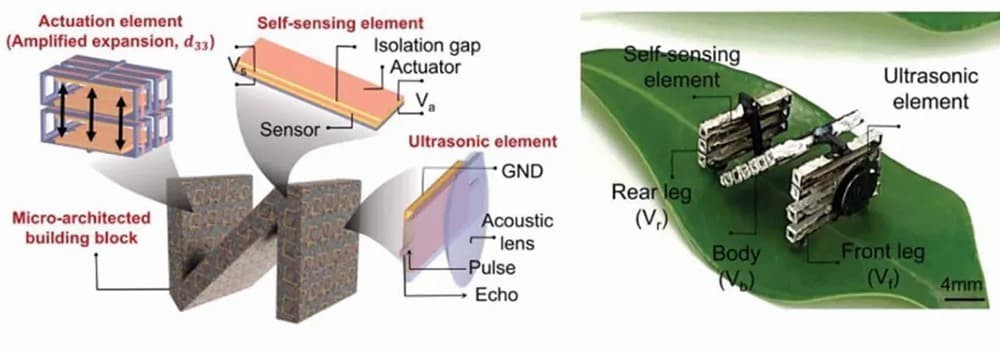
▲ Metamaterial proprioceptive robot
Other Applications of Piezoelectric Ceramics
In sensing applications such as non-destructive testing and structural health monitoring, piezoelectric ceramic devices must be customized according to the material properties or motion characteristics of the sensed object, similar to energy harvesters and ultrasonic devices. Especially in IoT applications, greater multifunctionality is demanded of sensors — they must sense temperature, strain, motion, flow rate, leakage, humidity, acoustic vibration and many other environmental parameters. Sensor materials therefore require high piezoelectric sensing coefficients and suitable acoustic impedance or pyroelectric response.
As for actuators, piezoelectric ceramics struggle to achieve large displacements; a single piece of ceramic is typically suitable for applications requiring high force (kN-level) with minute displacement range (μm-level). To obtain larger displacements, designs adopt unimorph or bimorph structures, or even elongated shapes such as spirals or springs, increasing stroke by utilizing the d₃₃ mode — at the cost of reduced blocking force.
In the biomedical field, the shapes of piezoelectric devices need to be individually customized to match patient needs, for example for active bone substitutes. In addition, devices such as transformers rely on dimensions and structural shape to tune the resonance frequency, thereby achieving energy conversion and control at the target frequency.
Conclusion
With the development of additive manufacturing technology, the geometric freedom of piezoelectric ceramics is being unleashed in unprecedented ways. From the most basic beam structures to metamaterial systems integrating actuation, sensing and adaptivity, shape is no longer merely the “shell” of a structure — it is the decisive factor of performance.
For future piezoelectric devices, shape is no longer a limitation but a source of potential. The deep integration of interdisciplinary design, material coupling and functional integration is leading us into a new era of piezoelectric ceramics.