Piezoelectric Ceramics: A Frontier Material Powering Ultra-Precision Development in High-Tech Industries
Piezoelectric Ceramics: A Frontier Material Powering Ultra-Precision Development in High-Tech Industries

As high technology continues to advance,…
As high technology continues to advance, the demands on the precision of modern engineering grow ever stricter. Piezoelectric materials are fabricated into sensors, actuators and other devices for precision and ultra-precision applications, enabling the measurement of microscopic deformation, stress measurement, nano-positioning and non-destructive testing.
Each piezoelectric material has its own strengths, weaknesses and application scenarios. Polycrystalline piezoelectric ceramics offer strong piezoelectric activity and high electromechanical coupling coefficients, impose no requirements on shape during processing, can be formed into arbitrary geometries, and offer significant cost advantages with mass-producibility. They can also undergo further processing and be integrated with other functional devices to meet the requirements of different fields. As a result, they are widely used across modern science, technology and daily life wherever ultra-precision machining is required.
Applications of Piezoelectric Ceramics in Precision and Ultra-Precision Fields
Owing to their direct and converse piezoelectric effects, piezoelectric ceramic materials are widely used in piezoelectric sensors, actuators, transducers and filters. Their application scope covers aerospace, military, information electronics, industrial machinery, medical, automotive and many other fields. According to statistics, the global piezoelectric materials and devices market is expected to reach USD 35.4 billion by 2026, with China accounting for more than 60% of global production, consumption and exports of piezoelectric materials and devices.
1. Piezoelectric Transducers
Piezoelectric transducers convert electrical energy into acoustic energy and vice versa by exploiting the direct and converse piezoelectric effects of piezoelectric ceramics. The piezoelectric ultrasonic transducer is an underwater acoustic device for transmitting and receiving ultrasonic waves underwater. When a submerged piezoelectric transducer is acted upon by sound waves, charges are induced at its two ends — this is an acoustic receiver; conversely, when an alternating electric field is applied to a piezoelectric ceramic disc, the disc alternately thins and thickens, vibrating and emitting sound waves — this is an ultrasonic transmitter.
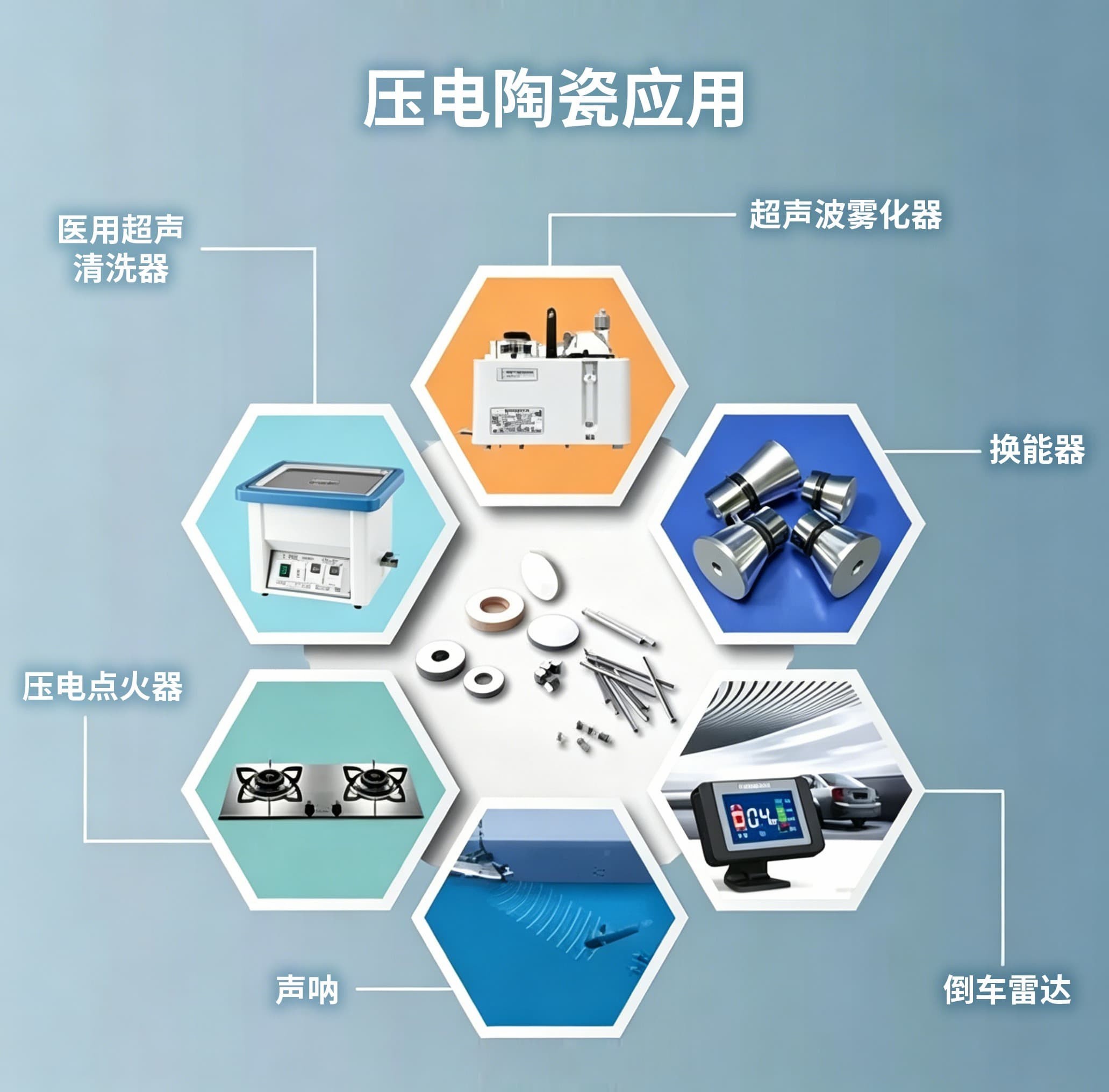
Piezoelectric transducers are widely used in underwater navigation, ocean exploration, ultrasonic cleaning, solid flaw detection, medical imaging, ultrasonic diagnostics and ultrasonic therapy. Another growing application area for piezoelectric ultrasonic transducers today is telemetry and remote-control systems.
● Applications in non-destructive testing.Non-destructive testing (NDT) technology uses acoustic, optical, electrical and magnetic techniques to detect whether a test object contains defects or inhomogeneities without damaging it, and to determine the size, location, nature and quantity of any defects.
Common NDT methods — ultrasonic testing, radiographic testing, machine-vision inspection, eddy-current testing and vibration testing — remain at a rudimentary stage for concrete damage detection and timber structure damage detection: they cannot locate or characterize internal damage, and their sensors are expensive. Piezoelectric ceramics, by contrast, are flexible in use and inexpensive, enabling localized and intelligent detection of damage in concrete and timber structures.
● Applications in piezoelectric energy harvesting.A piezoelectric energy harvester exploits the resonance characteristics of the piezoelectric vibrator and the piezoelectric effect of the material to convert ambient solar, vibration and acoustic energy into electrical energy. The same principle is also applied in piezoelectric ceramic ultrasonic motors. At present, piezoelectric energy harvesting is mainly used in road-surface piezoelectric power generation, converting the mechanical energy produced by passing vehicles into electricity.
In the selection of piezoelectric materials, lead zirconate titanate (PZT) is the most commonly used. However, studies show that under high-frequency cyclic loading, PZT is highly prone to fatigue cracking and brittle fracture. PZT therefore cannot withstand excessive stress in piezoelectric energy harvesting systems; the piezoelectric polymer polyvinylidene fluoride (PVDF) can be used instead — research shows that PVDF offers high toughness, long service life and high efficiency.
2. Piezoelectric Sensors
When a piezoelectric sensor operates, pressure applied to the piezoelectric element generates charge; after passing through the amplifier and impedance-conversion circuitry inside the sensor, this charge forms an electrical output proportional to the applied pressure, which is then discharged to keep the sensor operating normally. Such sensors are widely used in acoustics, medicine, mechanics and navigation.
● Applications in micro-displacement and 3D surface measurement.In the field of micro-displacement, piezoelectric ceramics are mainly used in ultra-precision feed systems. The micro-displacement measuring instrument of choice is the inductive gauge, with 0.01 μm accuracy, 0–10 μm measuring range, 200 N/μm stage stiffness and 27.6 μm travel. During voltage loading and discharge of the piezoelectric ceramic, dynamic displacement is generated: the ceramic’s displacement drives the stage to produce feed motion, while the displacement sensor feeds the displacement back to the control system to form closed-loop control. The inductive gauge communicates with the computer, and Matlab or LabVIEW is used to control the motion of the measuring platform.
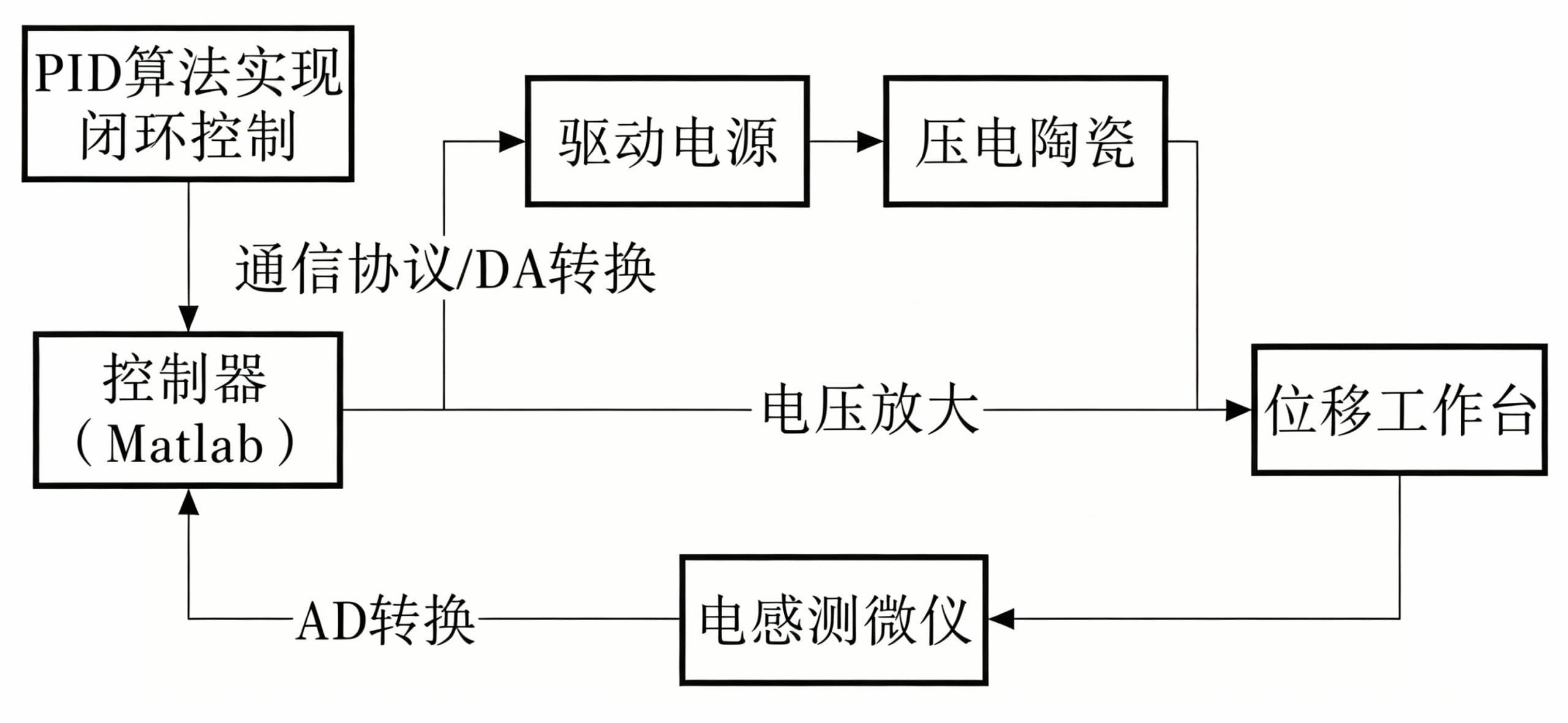
Block diagram of the feed system principle
In 3D surface measurement, the main methods are the mechanical stylus method, the optical probe method, the scanning probe method and phase-shifting interferometry, among which phase-shifting interferometry delivers the best results.
● Applications in micro-deformation and stress measurement.In micro-deformation and stress measurement, piezoelectric sensing elements are mainly used, applying the characteristics of piezoelectric ceramics to the measurement of force and of non-electrical physical quantities that are ultimately converted into force.
For micro-deformation, traditional measuring tools such as vernier calipers and the optical lever cannot meet the needs of precision and ultra-precision applications. Using the smart material piezoelectric ceramic together with sensors to measure the micro-deformation of precision and ultra-precision materials is therefore an important current research direction.
3. Piezoelectric Actuators
Piezoelectric actuators achieve motion control using the converse piezoelectric effect of piezoelectric materials. The resolution of piezoelectric ceramics can reach the nanometer level — even an order of magnitude finer — and motion can be linear along a specified direction. When an electric field is applied, the piezoelectric material undergoes mechanical strain and thereby produces motion. This motion can be used to drive mechanical systems, achieving precise position and motion control. Piezoelectric actuators are widely used in applications requiring high positioning accuracy and fast response, offering many advantages such as large output force, small size, fast response and high stiffness.
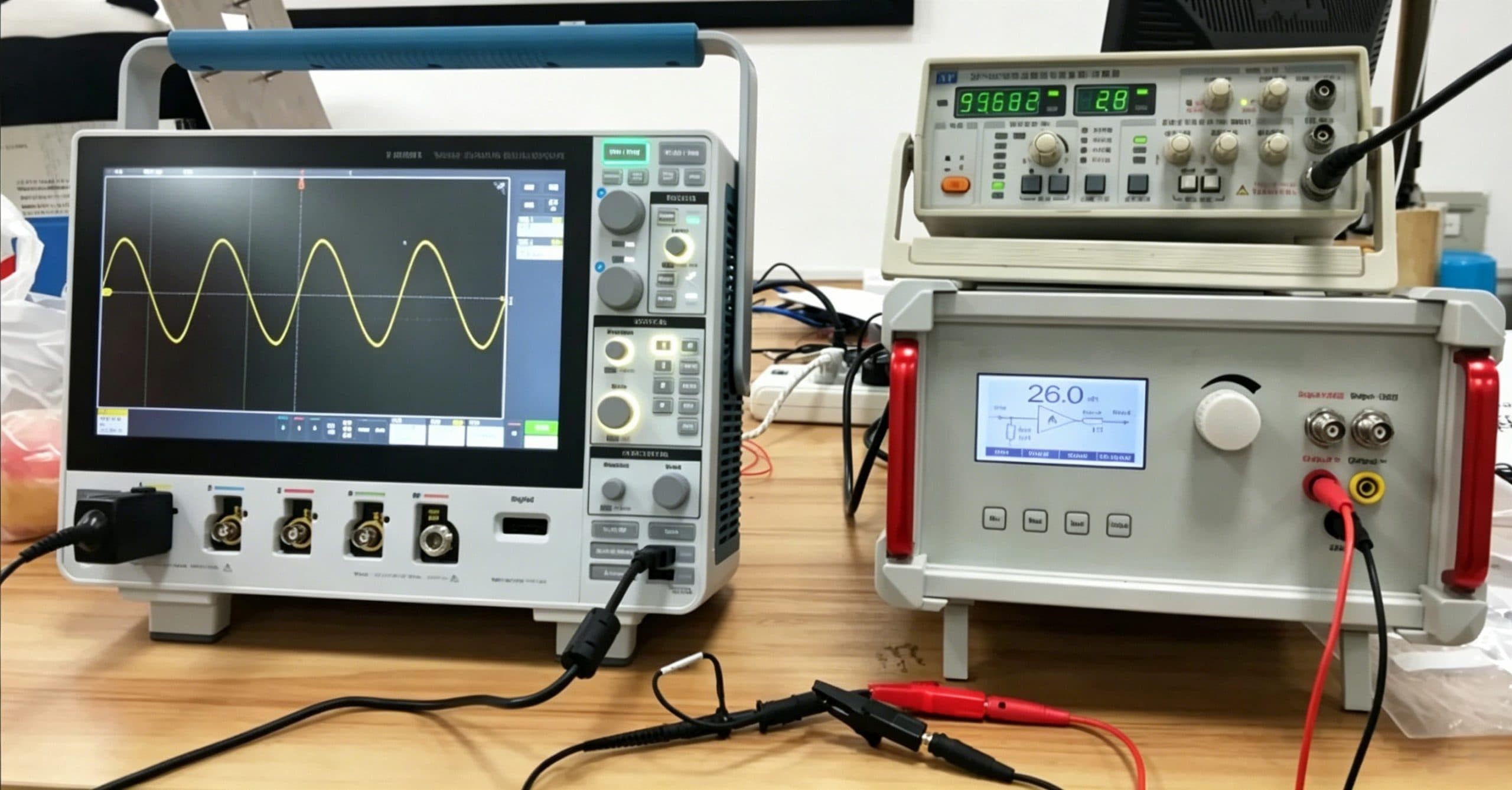
Piezoelectric ceramic actuator
The actuator is the core device of a micro-positioning stage and drives the stage. Micro-positioners are mainly used for positioning control at micrometer and sub-micrometer accuracy, for example in the manufacturing of optical instruments, optical fiber alignment, high-precision 3D micro-motion stages, high-precision machining and tunneling-effect research. In positioning technology, traditional positioning devices — mechanical-transmission micro-displacement actuators built from rolling or sliding guideways, precision screw-wedge mechanisms, turbine-cam mechanisms, gear-lever mechanisms and the like — suffer from large clearances and friction, making ultra-precision positioning impossible. Piezoelectric actuators combined with flexure-hinge amplification mechanisms overcome these drawbacks and achieve micro/nano-scale ultra-precision positioning.
Summary
Overall, as a principal functional material in modern industrial production, piezoelectric ceramics drive material development through their inherent advantages. Favoured by numerous high-tech industries for their many strengths, they are attracting ever more research in precision and ultra-precision fields. With the rapid development of emerging fields and new economic and social development needs, still higher performance will be required of piezoelectric ceramics in the future: high Curie temperature, high electromechanical coupling coefficients and mechanical quality factors, as well as environmentally friendly, lead-free, composite and nano piezoelectric ceramics, will inevitably become the focus of future research.