Strategic Research: Strategic Thinking on the Development of China’s Electronic Ceramics Technology
Strategic Research: Strategic Thinking on the Development of China’s Electronic Ceramics Technology

Electronic ceramics, an important class …
Electronic ceramics, an important class of strategic new materials, are the core material of passive electronic components and an important technological frontier in the field of electronic information technology. As electronic information technology increasingly moves toward integration, intelligence and miniaturization, passive electronic components are becoming the bottleneck of electronic component technology, and the strategic position of electronic ceramic materials and their preparation and processing technologies is increasingly prominent. China has built a solid industrial and technological foundation in electronic ceramic materials and components, but its competitiveness in high-end materials and components remains insufficient, and a number of key material, process and equipment technologies are dependent on others. The study concludes that, facing the new situation, it is urgent to increase R&D investment, streamline institutional mechanisms, and strengthen the self-reliance, controllability and independent innovation of the industrial chain. Keywords: electronic ceramics; passive electronic components; high-end materials
1. Introduction
Electronic ceramics are the core material of passive electronic components and an important material foundation of electronic information technology. In recent years, as electronic information technology has increasingly moved toward integration, thinness, intelligence and miniaturization, semiconductor-based active devices and integrated circuits have developed rapidly, while passive electronic components have increasingly become the bottleneck of electronic component technology. Electronic ceramic materials and their preparation and processing technologies have therefore become one of the important core technologies constraining the development of electronic information technology.
China is a major producer of passive electronic components: in terms of output, it accounts for more than 40% of global passive component production. Yet it is not a strong player — its component output value is less than a quarter of the global total, and high-end components rely heavily on imports. Electronic ceramic materials and technologies are one of the important factors constraining the development of high-end components. Assessing the development status of electronic ceramic materials and component technologies at home and abroad from a strategic height, and analyzing the problems and countermeasures in China’s related fields, is of great significance for promoting the development of China’s high-end electronic component industry.
2. Current Status and Trends of International Electronic Ceramics Industrial Technology
In terms of global electronic ceramics technology, Japan and the United States hold the world’s leading positions. Japan, with its ultra-large-scale production and advanced preparation technology, occupies a dominant position in the world electronic ceramics market with more than 50% market share. The United States has strong capabilities in basic research and new material development, focusing on cutting-edge product technologies and military applications, holding advantageous positions in underwater acoustics, electro-optics, optoelectronics, infrared technology and semiconductor packaging. In addition, South Korea has developed rapidly in the field of electronic ceramics and attracted considerable attention.
(1) Multilayer Ceramic Capacitor (MLCC) Industry
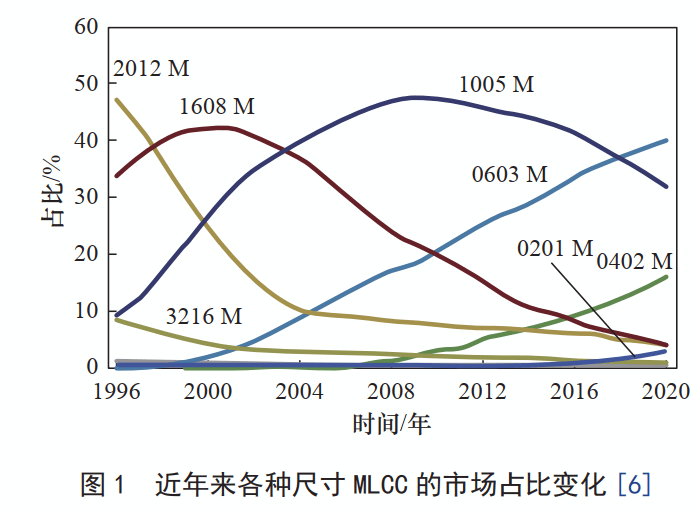
The main application field of electronic ceramics is passive electronic components. MLCCs are among the passive components with the largest usage, mainly used in oscillation, coupling, filtering and bypass circuits of various electronic devices, with applications spanning automatic instruments, digital home appliances, automotive electrics, communications, computers and other industries. MLCCs occupy an increasingly important position in international electronics manufacturing. In particular, with growing demand from consumer electronics, communications, computers, networks, automotive, industrial and defense end customers, the global market has reached tens of billions of dollars and is growing at 10%–15% per year. Since 2017, due to supply-demand dynamics, MLCC products have experienced several rounds of price increases. Japan is a major MLCC producer: Japan’s Murata, KYOCERA, TAIYO YUDEN and TDK-EPC, South Korea’s Samsung Electro-Mechanics (SEMCO), and Taiwan’s Walsin Technology and Yageo are all globally renowned MLCC manufacturers. The mainstream development trends of MLCCs are miniaturization, high capacitance, thinner dielectric layers, base-metal electrodes and high reliability. Among these, technologies for base-metal inner electrodes have developed most rapidly in recent years — adopting base-metal inner electrodes is the most effective way to reduce MLCC cost, and the key to base-metalization is developing high-performance anti-reduction barium titanate ceramic powders. Japan completed the development of this technology at the beginning of the 21st century and has maintained world leadership ever since; its high-capacitance MLCCs are now fully base-metalized. Miniaturization has always been the main trend of MLCC development. As electronic devices increasingly move toward small and portable form factors, products are upgraded rapidly and demand for miniaturized products is strong, as shown in Figure 1. The fundamental material technology for miniaturized components is the thinning of ceramic dielectric layers. Japanese companies currently hold the international lead: the MLCC single-layer thickness they produce has reached 1 µm, and the R&D level of the top players, Japan’s Murata and TAIYO YUDEN, has reached 0.3 µm. The foundation of dielectric thinning is the refinement of dielectric materials. As the single-layer thickness of high-capacitance thin-layer MLCC components gradually decreases, the grain size of barium titanate — the main crystalline phase of the MLCC ceramic dielectric — needs to be further refined from 200–300 nm to 80–150 nm to ensure component reliability. The future trend is to prepare barium titanate materials with grain sizes ≤150 nm as the main crystalline phase material of MLCC dielectric layers.
(2) Chip Inductor Industry
Chip inductors are another category of passive electronic components with large usage — the most technically complex of the three major categories of passive chip components — and their core material is magnetic ceramics (ferrite). Total world demand for chip inductors is currently around one trillion pieces, with annual growth above 10%. In chip inductor development and production, Japan accounts for about 70% of total world output, with TDK-EPC, Murata and TAIYO YUDEN consistently holding the field’s cutting-edge technologies. According to the Industrial Economics and Knowledge Center (IEK), in the global inductor market the combined output of TDK-EPC, TAIYO YUDEN and Murata accounts for about 60% of the global market. The main development trends of chip inductors include small size, high inductance, high power, high frequency, high stability and high precision. The technological core is soft magnetic ferrite and dielectric materials with low-temperature sintering characteristics.
(3) High-Performance Piezoelectric Ceramics Industry
Piezoelectric ceramics are an important transducer material with excellent electromechanical coupling performance, widely used in electronic information, electromechanical transduction, automatic control, micro-electromechanical systems and biomedical instruments. To meet new application requirements, piezoelectric devices are developing toward multilayer, chip and miniature forms. In recent years, new piezoelectric devices such as multilayer piezoelectric transformers, multilayer piezoelectric actuators and chip-type piezoelectric frequency devices have been continuously developed and widely applied in electrical, electromechanical and electronic fields.
Meanwhile, in new materials, research on lead-free piezoelectric ceramics has achieved major breakthroughs that could allow lead-free piezoelectric ceramics to replace lead zirconate titanate (PZT)-based piezoelectric ceramics in many fields, driving the upgrading of green electronic products. In addition, piezoelectric materials are beginning to show promise in next-generation energy technologies. Over the past decade, with the development of wireless and low-power electronics, research and development of micro energy harvesting technology using piezoelectric ceramics has received great attention from governments, institutions and enterprises worldwide.
(4) Microwave Dielectric Ceramics Industry
Microwave dielectric ceramics are the cornerstone of wireless communication devices, widely used in mobile communications, navigation, global satellite positioning systems, satellite communication, radar, telemetry, Bluetooth and wireless local area networks (WLAN). Filters, resonators, oscillators and other components made of microwave dielectric ceramics are widely used in 5G networks, and their quality largely determines the final performance, size limits and cost of microwave communication products. Low-loss, high-stability, tunable microwave electromagnetic dielectric materials are currently the core international technology. In the early stage of development, microwave dielectric ceramic materials saw fierce competition among the United States, Japan and Europe, but Japan subsequently gained a clear advantage. With the rapid development of third-generation mobile communication and data microwave communication, the US, Japan and Europe have all made strategic adjustments for the development of this high-tech field. Judging from recent trends, the United States has made nonlinear microwave dielectric ceramics and high-dielectric-constant microwave dielectric ceramic material technology its strategic focus; Europe emphasizes materials for fixed-frequency resonators; and Japan, relying on its industrialization advantages, vigorously promotes standardization and high quality of microwave dielectric ceramics. At present, the highest production levels of microwave dielectric materials and devices belong to Japan’s Murata, KYOCERA and TDK-EPC, and the United States’ Trans-Tech, among others.
(5) Semiconductor Ceramics Industry
Semiconductor ceramics are a class of information functional ceramic materials that convert physical quantities such as humidity, gas, force, heat, sound, light and electricity into electrical signals. They are widely used and are the main foundational material of IoT technology — for example positive temperature coefficient thermistors (PTC), negative temperature coefficient thermistors (NTC) and varistors, as well as gas and humidity sensors. Thermistor and varistor ceramics have the highest output and output value among semiconductor ceramic materials. Internationally, the most advanced thermistor ceramic materials and devices with the largest output come from Japan’s Murata, Shibaura Electronics, Mitsubishi, TDK-EPC and Ishizuka Electronics, the United States’ VISHAY and Germany’s EPCOS; their combined annual output accounts for about 60%–80% of the world total — high quality, but at high prices. In recent years, foreign ceramic semiconductor devices have been developing toward high performance, high reliability, high precision, multilayer chip form and large scale. A number of large foreign enterprises have successively launched chip-type semiconductor ceramic devices based on multilayer ceramic technology, becoming high-end products in the sensor field.
3. Development Status of China’s Electronic Ceramic Materials and Components
China is a major electronic component country: the output of many electronic ceramic products ranks first in the world, a number of component production bases with certain international competitiveness have been formed, and it has the world’s largest application market. However, the high-end electronic ceramic materials market is currently monopolized mainly by Japanese companies; only a small portion of domestically produced materials are used in high-end component products, with most going to mid- and low-end components. High-level domestic research achievements encounter bottlenecks in raw materials, production equipment and stability during transformation, and hold a relatively low market share.
In terms of industrial technology, China’s electronic ceramics and component production bases have reached considerable scale and possess internationally advanced production levels. Among them, Fenghua Advanced Technology is one of the few comprehensive international enterprises with a “trinity” industrial system integrating electronic components, electronic materials and special electronic equipment; Sunlord Electronics has clear international competitive advantages in chip inductors and low-temperature co-fired ceramic (LTCC) products; and leading backbone enterprises in the ceramic electronic component industry such as Chaozhou Three-Circle Group and Shenzhen Yiyang Technology also have international influence and have received support from a series of national R&D programs. The Electronic Technology Innovation Strategic Alliance, led by Tsinghua University and Fenghua Advanced Technology and jointly established by 20 large and medium-sized enterprises, research institutions and universities, has played an important role in promoting the combination of functional ceramic chip component and passive integration ceramic material R&D with industry.
(1) MLCC Industry
China’s MLCC industry is large in scale, having produced a number of internationally competitive large enterprises represented by Fenghua Advanced Technology and Shenzhen Yiyang Technology that hold a place in international competition. However, since the world’s top MLCC manufacturers — Japan’s TAIYO YUDEN, Murata, KYOCERA and TDK-EPC, and South Korea’s SEMCO — have successively established manufacturing bases in mainland China and shifted capacity there, more than half of domestic MLCC output is currently occupied by foreign-funded and joint-venture enterprises. Meanwhile, the domestic market relies mainly on imports for high-end MLCC products. Lacking independent intellectual property rights and advanced process equipment, high-performance ceramic powders, electrode pastes and advanced production equipment all depend heavily on foreign vendors. From the market perspective, MLCC consumption is concentrated in Asia, accounting for 75% of global MLCC consumption, with China accounting for more than half. With the continuous expansion of complete-machine manufacturing such as mobile communication products, China’s MLCC product demand is still growing rapidly.
(2) Chip Inductor Industry
China began developing and producing chip inductors and related materials in the early 1990s. It has now basically established an inductor industry balancing traditional and new products, with considerable economic scale and a certain position in the international market, with output accounting for about 20% of total world production. Among the players, Shenzhen Sunlord Electronics has secured a place in international competition by virtue of its technological advantages in materials and processes. However, domestic chip inductor manufacturers still face problems: most products target consumer electronics, while such foundational components for communications and automotive electronics are monopolized by Japanese, Korean and Taiwanese enterprises. At the same time, price wars in the low-end market have squeezed the profit margins of domestic chip inductor manufacturers. Global demand for chip inductors keeps growing and the market structure keeps changing — especially in mobile/wireless communication, where growth is remarkable. Manufacturers of mobile communication products represented by mobile phones are mostly in China, yet most chip inductors for mobile communication are currently supplied from abroad. Computers and automotive electronics are also domestic fields with rapid growth in demand for high-end chip inductor products. For some time to come, China’s market gap in high-end chip inductors will be considerable.
(3) High-Performance Piezoelectric Ceramics Industry
In high-performance piezoelectric ceramics and components, mainland China has many piezoelectric ceramic enterprises, but most are small and medium-sized with product structures dominated by low-end products. Although China’s piezoelectric ceramics R&D has produced a number of technological achievements with independent intellectual property rights over the past decades, the overall market competitiveness and industrial technology level of the industry urgently need improvement, and the product structure awaits upgrading. With the rapid development of information technology, new energy technology, biomedicine and aerospace technology, the application markets of some new piezoelectric ceramic devices will rise rapidly and become the main market for piezoelectric ceramic devices.
(4) Microwave Dielectric Ceramics Industry
In microwave dielectric ceramic materials, China’s research started early, basically in step with developed countries, initially focused on the research, development and production of key microwave devices for national defense. Over the past decade, several enterprises of certain scale have emerged, such as Wuhan Fingu Electronic, Jiali Electronics, Tatfook Technology, Shenzhen Sunlord Electronics and Jiangsu Caiqin Technology. However, compared with internationally renowned large enterprises, these companies still lag considerably in technical level, product variety and production scale. The rapid rise of wireless information technology — represented by 5G, the wireless internet, wireless sensor networks, and satellite communication and positioning systems — places higher requirements on high-performance microwave devices, and the development space is large.
(5) Semiconductor Ceramics Industry
At present, most domestic semiconductor ceramics and related sensor manufacturers were established in the 1990s, with foreign-funded and private enterprises as the main body. Foreign enterprises have rapidly established production bases in the domestic market through wholly-owned or joint-venture arrangements, with significant technological advantages, excellent product performance and large exports, occupying a dominant position in the domestic high-end market. Technically, private enterprises lag behind in production processes and remain deficient in raw materials, production equipment, testing equipment and quality control, resulting in a single domestic product line dominated by mid- and low-end products unable to meet high-end market demand. In terms of future demand, the rapid development of the IoT and sensor networks will bring explosive growth in China’s demand for semiconductor ceramic sensors, and considerable development space remains ahead.
4. Analysis of Major Technology Needs for Electronic Ceramic Materials
As electronic information products further develop toward broadband, miniaturization, integration, wireless/mobility and greenness, the multifunctionalization, multilayering, chipping of multilayer components and integration of chip components of electronic ceramic components have become the mainstream of development. These new trends place a series of new demands on electronic ceramic materials, such as fine-grained material microstructures, diversification of material functions, and high-frequency and low-loss electromagnetic properties. Related material technologies are increasingly becoming the bottleneck constraining information technology development. In the coming years, the key technical problems urgently awaiting solution in the development of electronic ceramic materials include the following.
(1) New electronic ceramic materials and key technologies for new electronic information systems satisfying component miniaturization/micronization — such as nanocrystalline material preparation technology and ultra-thin ceramic film forming processes; ultra-low-loss dielectric ceramic materials for key microwave components in low-energy wireless/mobile information systems.
(2)New electronic ceramic materials adapted to the characteristic frequencies of new-generation mobile communication technology. With the development of 5G/6G technology, communication bands are gradually advancing from microwave to millimeter wave; demand for new electronic ceramics — especially ceramic dielectric materials — suitable for higher frequency bands will increase sharply, and developing related materials and devices is extremely urgent.
(3)New electronic ceramic materials for passive component integration, passive-active integration and modularization. Passive integration technology based on the LTCC platform will have greater development space, and the various functional ceramic materials compatible with this technology and their co-firing technology are a technical bottleneck urgently awaiting breakthrough.
(4)New functional electronic ceramic materials oriented to the multifunctionalization of electronic information systems — new multifunctional ceramic material systems with coupled electrical, magnetic, optical and thermal behaviors and extraordinary electromagnetic properties, and new information functional ceramic materials with stability and excellent service behavior under complex external fields or extreme environmental conditions.
(5)Other technical fields also place new demands on electronic ceramic materials. In energy materials, the further development of solid fuel cells, solar cells and semiconductor lighting technology depends on breakthroughs in electronic ceramic materials and their preparation technology; with the rise of the IoT and sensor networks, the wide variety of sensors requires more and higher-performance new sensitive ceramic materials.
5. Main Problems Facing the Development of China’s Electronic Ceramics Industry
The main problems currently facing the development of China’s electronic ceramics and component industry include the following.
(1) Seriously Insufficient Social Attention
The importance of electronic ceramic materials in electronic information technology is second only to semiconductors. However, compared with semiconductor technology, attention from all sectors of society is seriously insufficient. As Hideki Maruyama, president of Murata (China), pointed out: China’s national policy supports chips and semiconductors, but there is no major support for components, so China’s component enterprises mostly develop on their own. Due to insufficient social investment, enterprises lack mechanisms to attract high-level talent, R&D strength is weak, R&D funding is scarce, and it is difficult to meet rapidly evolving R&D needs.
(2) Research Achievement Transformation Mechanism Needs Improvement
Domestic R&D of electronic ceramic materials is scattered among a few universities, research institutes and a small number of large enterprises; within universities and institutes it is divided between materials and component fields with widely differing emphases, disconnected from each other, lacking systematic research integrating materials, processes and components. The transformation of R&D achievements into industrialization is neither timely nor sufficient. Universities, institutes and enterprises are institutionally separated, with insufficient exchange and collaboration, lacking an effective mechanism for the timely and effective transformation of achievements and the concrete realization of “industry-university-research” integration. Research achievements of universities and institutes often remain at the laboratory stage without small-scale trials or mass-production verification, while corporate R&D is often insufficiently deep due to the lack of experimental analysis equipment.
(3) Imperfect Domestic Industrial Chain Support for Independent Innovation
Electronic ceramic materials sit in the middle and upper reaches of the industrial chain, with raw materials upstream and components downstream. Because component process equipment and technical standards mainly come from abroad, and domestic raw material products still lag behind foreign products in stability and consistency, the large-scale application of domestic electronic ceramic materials in component products is constrained. In particular, some original materials are difficult to apply due to lack of compatibility with existing component technology, making it difficult for domestic electronic ceramic materials and components to take the lead in the industry.
(4) Mass Production Process Equipment Level Needs Improvement
At present, the process equipment for domestic high-end electronic ceramic materials and components is still mainly imported. Due to rapid technological iteration, advanced technology is difficult to bring into China, making it hard for mass production levels to hold global leadership. Taking the leading enterprises of the domestic ceramic passive component industry as examples, Fenghua Advanced Technology, Sunlord Electronics and Yiyang Technology are all domestic backbone enterprises mainly engaged in chip component production, but the technical level of their high-end products still lags far behind internationally renowned companies such as TDK-EPC and TAIYO YUDEN.
6. Strategic Goals and Path for Electronic Ceramics Industry Development
(1) Overall Approach
Further increase R&D investment in electronic ceramic materials and related components, focusing on breakthroughs in high-end electronic ceramic materials, advanced processing technology and key equipment technologies; accelerate the localization and independent innovation of the whole industrial chain of electronic ceramic materials and components, forming independent intellectual property systems and technological advantages; improve the mechanism for industrializing electronic ceramic material achievements, and establish R&D systems and production bases for electronic ceramic materials with internationally advanced levels, as well as world-class component process manufacturing bases. Enable China to reach internationally leading levels in several fields: industrialization technology for ultra-thin base-metal inner-electrode MLCCs and their ferroelectric ceramic materials; low-temperature sintering high-performance chip inductors (MLCI) and their ferrite material industrialization technology; high-performance piezoelectric ceramics and their new component industrialization technology; high energy storage density dielectric ceramic materials and their engineering preparation technology; microwave dielectric ceramics industrialization technology; and semiconductor ceramics and sensor component industrialization technology.
(2) Strategic Goals
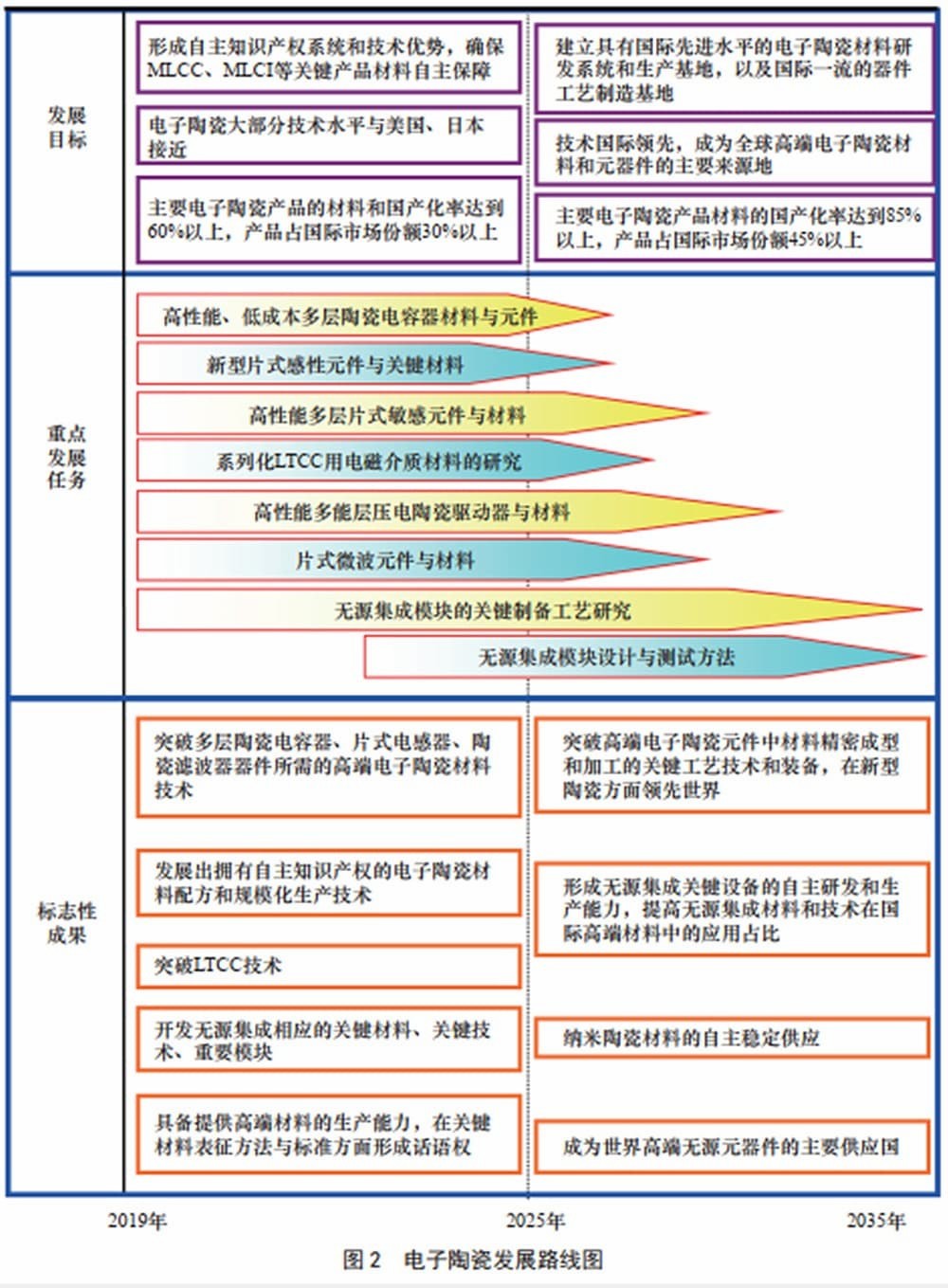
Facing the urgent needs of information technology and other fields, further increase support for electronic ceramics technology R&D and industrial upgrading, break through the key technologies troubling the industry’s technological progress, and bring China’s technological level in this field to the forefront of the world. Strive to approach the levels of the United States and Japan in most areas by 2025, and to become the world’s main source of high-end electronic ceramic materials and components by 2035 (see Figure 2).
(3) Key Development Directions
1. New-generation electronic ceramic components and materials
Focus on breakthroughs in high-end electronic ceramic material technologies needed for high-volume passive components such as MLCCs, chip inductors and ceramic filters; develop material formulations and mass production technologies with independent intellectual property rights and form stable production scale. Focus on breakthroughs in key process technologies and equipment for precision forming and machining of materials in high-end electronic ceramic components; ensure the independent and stable supply of key nano ceramic materials required for thin multilayer ceramic technology; and form independent R&D and production capabilities for key passive integration equipment.
(1) High-performance, low-cost MLCC materials and components. Strengthen high-performance anti-reduction ceramic dielectric powders and their mass production; focus on R&D of thin functional ceramic forming technology and equipment, nanocrystalline ceramic sintering technology, and ultra-thin multilayer ceramic structure inner electrode technology.
(2) New chip inductive components and key materials. Strengthen high-performance low-temperature sintering ferrite and low-dielectric low-loss ceramic dielectric powders and their mass production; develop multilayer ceramic precision interconnection technology and equipment, and miniaturized microwave-band chip inductor wiring design technology.
(3) High-performance multilayer chip sensitive components and materials. Focus on mass production technologies for high-performance chip thermistors, gas, humidity, varistor and photosensitive ceramics; micro/nano-scale multilayer chip sensitive ceramic sensor preparation process technology and characterization technology.
(4) High-performance piezoelectric ceramic materials. Focus on net-shape forming and machining of piezoelectric ceramic materials and their industrialization technology; preparation and industrialization of high-performance multilayer piezoelectric materials for piezoelectric micro power sources; and advanced preparation technology enabling the engineering and industrialization of high-performance multilayer lead-free piezoelectric ceramic materials and new components.
(5) New-generation electromagnetic wave dielectric ceramic materials. For 5G/6G communication technology, focus on chip high-frequency low-loss microwave dielectric ceramics and their mass production technology; mass production technology and equipment for chip high-performance low-cost composite electromagnetic wave dielectric ceramics and their base materials; and the design, preparation and mass production technology of artificial chip electromagnetic wave dielectrics.
2. Passive integration modules and key materials and technologies
Whether passive integration technology can enter the stage of practical application and industrialization depends largely on breakthroughs in LTCC technology. Although several passive integration technologies with respective advantages have been developed, the mainstream remains LTCC. On one hand, optimize LTCC material properties and preparation methods to increase the share in international high-end applications; on the other hand, balance the other types of passive integration technology and develop the corresponding key materials, key technologies and important modules.
(1) Research on serialized LTCC electromagnetic dielectric materials. Focus on ceramic material powders and production tapes with serialized dielectric constants and permeabilities that satisfy LTCC performance and process requirements, forming China’s independent intellectual property rights in the field of LTCC materials.
(2) Research on key preparation processes for passive integration modules. Focus on several key process steps in the preparation of passive integration modules, such as thick-film and thin-film preparation, micro via-hole forming and slip casting, precision conductor paste printing, and ceramic co-firing.
(3) Design and testing methods for passive integration modules. Research content includes the development of passive integration module design software, simulation of the characteristics of novel passive integration structures, design of high-density passive integration modules, and testing technology for passive integration modules.
7. Policy Recommendations
China has formed a good industrial and technological foundation in electronic ceramic materials and components. However, as an important class of strategic new materials, the robust development of electronic ceramics in the high-end field is still constrained by key material, process and equipment technologies. To achieve the leading development of China’s high-end electronic ceramics industry, it is urgent to strengthen top-level planning.
(1) Incorporate passive components and key electronic ceramic materials and passive electronic components into the national semiconductor industry development strategy for overall consideration; establish a special program for passive components within the major national R&D programs supporting the microelectronics industry; and extend the various preferential policies supporting the chip industry to the electronic ceramics and passive electronic component industries.
(2) Increase researcher numbers and funding, strengthen R&D capabilities overall, strengthen direct ties and collaboration among research institutions, and create a comprehensive R&D body based on new materials research with strong component application research background and capability; establish an effective mechanism for the timely and effective transformation of achievements and the concrete realization of “industry-university-research” integration.
(3) Coordinate planning of upstream and downstream enterprises in the electronic ceramic materials and component industrial chain; strengthen the raw material supply chain to ensure the supply of high-purity, high-stability electronic ceramic precursors; vigorously carry out R&D of high-end process equipment; strengthen independent innovation in passive component and complete-machine industry design; and strengthen the development of related standards.